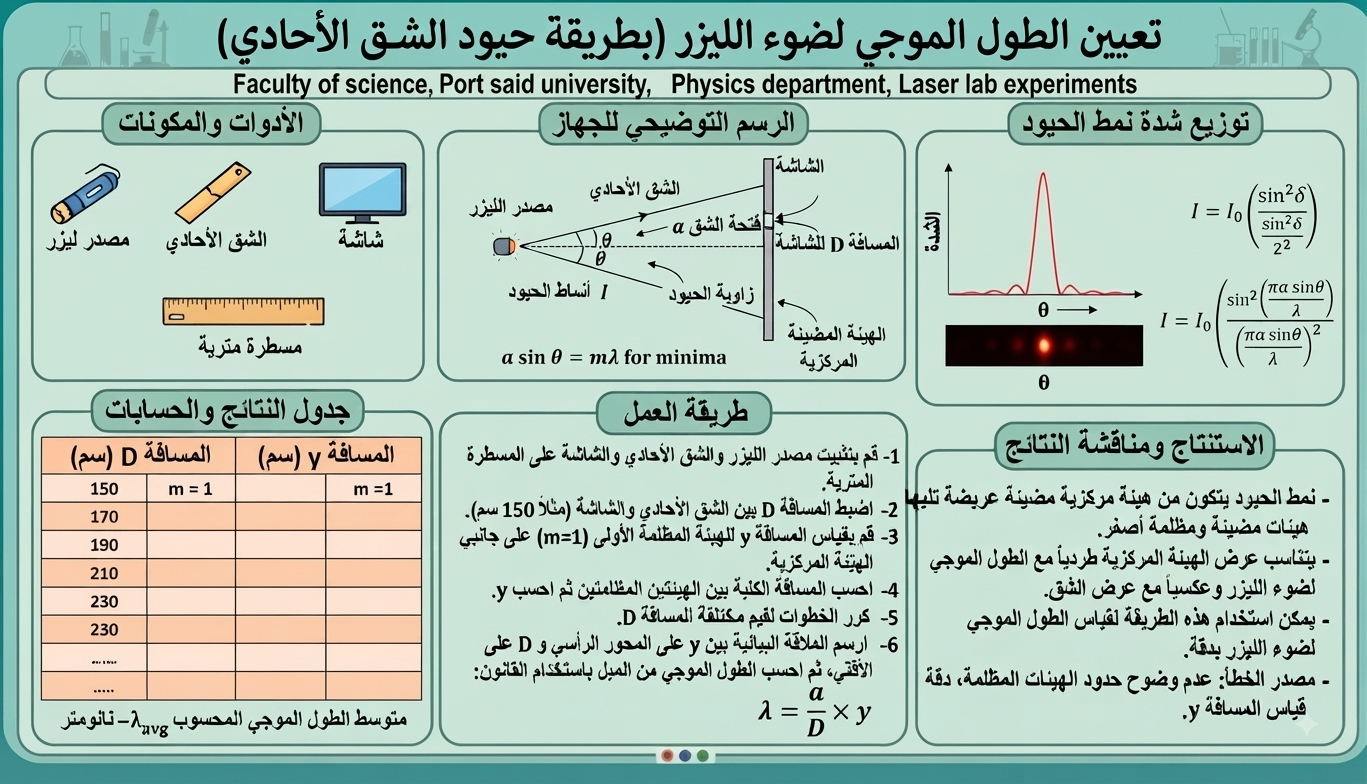
Single Slit Diffraction
1- Study the diffraction pattern using single slit.
2- Determine the wavelength of laser.
In physics, Diffraction of light is the bending of light waves around an object. The amount of light diffracted or which changes direction is dependent on an object's size and these changes can be seen. Light which passes through a narrow slit does not produce a sharp geometrical shadow, but a distributed pattern of light intensity produced by diffraction.
Under the Fraunhofer conditions, the wave arrives at the single slit as a plane wave. The resulting relative intensity will depend upon the total phase displacement δ according to the relationship:
I = I₀ sin²(δ/2) / (δ/2)²
This phase angle can be related to the deviation angle θ by:
δ = 2πa sin θ / λ
The minimum intensity occurs at an angle θ_min given by:
a sin θ_min = m λ
1- Laser source
2- Single slit
3- Screen
4- Meters stick
- 1- Adjust the laser beam to fall on slits.
- 2- Adjust the distance from the slits to the screen (D) 150 cm.
- 3- Let m constant at m = 1.
- 4- Increase D by 20 cm in every step and calculate y in each step.
- 5- Draw the relation between y (cm) on vertical axes and D (cm) on horizontal axes, then calculate the slope of the line and then calculate λ.
Media Gallery